Measuring polarized dust
The methods under everything else: how to estimate polarization fraction and angle without bias, and how the Planck satellite and the PILOT balloon measure them.
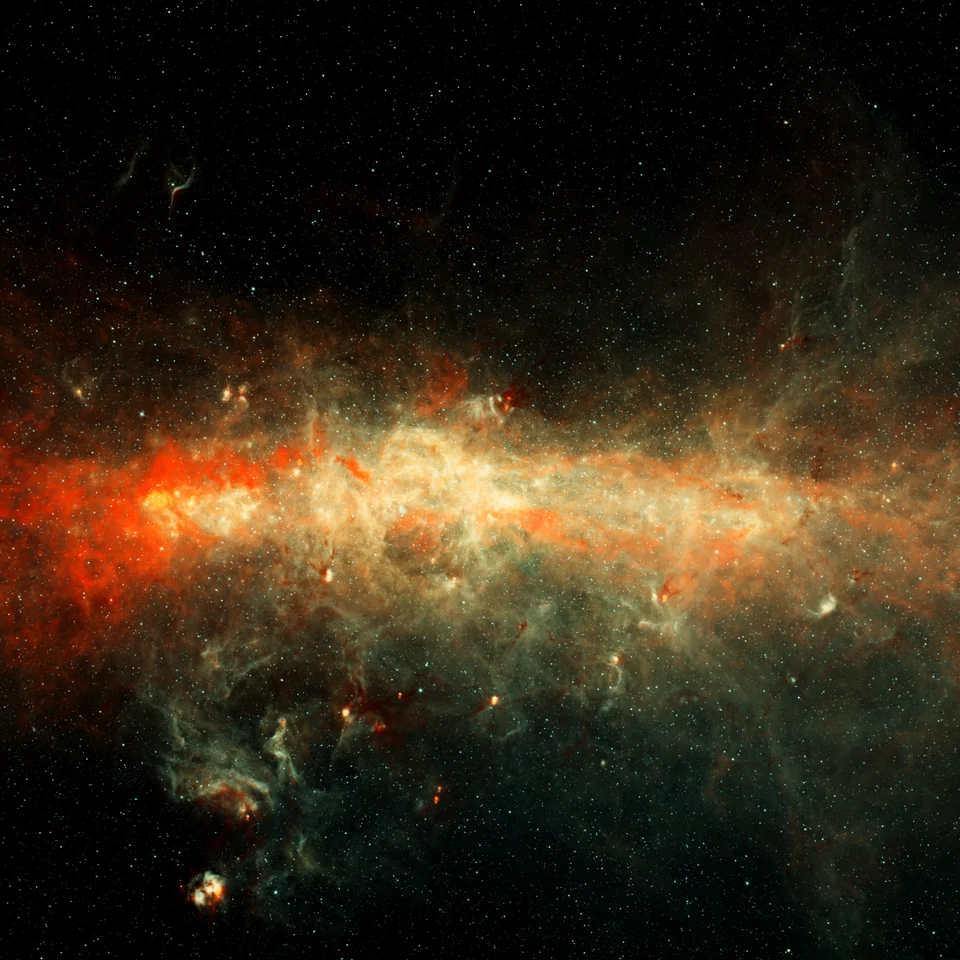
Polarization fraction and angle are noisy, non-linear quantities, and naive estimates are biased at low signal to noise. Part of the group’s work is the statistics needed to read such maps without bias, and part is the instruments: the Planck all-sky survey and PILOT, a balloon that measured dust polarization towards the Galactic centre.
Results
What the papers report, in their own terms. Each item links to its source.
PILOT mapped polarized dust emission at 240 µm over the whole central molecular zone. The plane-of-sky field it implies is ordered across the full CMZ and tilted clockwise from the Galactic plane.
average tilt ≃ 22°
Mangilli et al. 2019The usual simplified noise covariance is safe when the Q and U noise is close to symmetric. When the intensity itself is noisy, its uncertainty greatly widens the uncertainty on the polarization fraction without changing the relative bias.
intensity S/N < 10
Montier et al. 2015At low signal to noise the traditional estimators of polarization fraction have discontinuous output distributions; the asymptotic and Bayesian estimators do not, and the asymptotic one comes closest to a Gaussian.
Montier et al. 2015The conventional estimator of the polarization angle dispersion function is biased up or down depending on its true value. A diagonal noise covariance is adequate only while the Q-U noise ellipticity varies by less than 10 per cent.
Alina et al. 2016
Bias at low signal to noise
Noise biases the polarization fraction and the angle dispersion function. Try the estimators the group has studied.
Fraction
Noise in Q and U adds to the length of the polarization vector on average, so the measured fraction p comes out too high when the signal to noise is low. Set a true fraction and a noise level: the bench draws 2000 noisy measurements and applies four estimators to each. The red line is the true value; the triangle marks each estimator's mean.
Signal to noise runs from 0.3 to 10 on a log scale. Ellipticity 1 is equal, independent noise on Q and U; up to 1.1 is the low regime and up to 2 the extreme one (Montier et al. 2015a).
| Estimator | Mean | Bias | At zero |
|---|
Naive is √(Q² + U²). Asymptotic subtracts the noise in quadrature and returns zero below it, so a large share of low signal-to-noise points end up at exactly zero. MAS, the modified asymptotic estimator of Plaszczynski et al. 2014, keeps the same high signal-to-noise limit but stays positive and continuous. Mean posterior is the Bayesian estimator with a flat prior on p0 between 0 and 1; it can never fall below about 0.8σ. With elliptical noise, asymptotic and MAS use the noise across the direction of the measured (Q, U) vector (Montier et al. 2015b, Eq. 15), and the mean posterior uses the full covariance. Montier et al. 2015b recommend MAS for maps, with the lowest bias and a near-Gaussian output above a signal to noise of 2; the mean posterior has the lowest risk between 1 and 3. Above 4 all of them agree.
Dispersion
The angle dispersion function S measures how much the field direction changes around a point: the rms difference between the angle at the centre and its neighbours. Noise pushes it towards 52°, the value for random angles, so it is biased up when the field is ordered and down when it is tangled. The setup follows Alina et al. 2016: ten pixels, p0 = 10%, and every neighbour differing from the centre by the true S0.
Conventional is the rms of the measured angle differences (Alina et al. 2016, Eq. 5). Variance subtracted removes the propagated uncertainty, S² − σS² (Planck Collaboration Int. XIX 2015, Eq. 8 and 9); that paper notes the approximation is poor at low signal to noise. Dichotomic multiplies angle differences from two independent halves of the data, each with √2 more noise (Alina et al. 2016, Eq. 18). Its square can be negative, so the curve shows the root of its mean. Alina et al. 2016 find it is always biased low, while the conventional estimator is biased high below 52° and low above, so the two bracket S0 for an ordered field.
A Planck patch
The same correction on real data: Planck PR4 353 GHz polarized intensity on a 4° field at the western edge of the LMC, smoothed to 11.2′ with the noise covariance of every pixel carried through the smoothing. MAS changes little where the signal is strong and pulls the faint pixels down.
North is up and east to the left; the field is centred on RA 74°, Dec -67°. The maps use a Gaussian kernel of 10′ FWHM on top of the native beam of about 5′, and the Q and U variances are summed with the squared kernel weights, which lowers σ by about a factor of nine. Pixel noise correlations are not in the Planck covariance columns, so σ here is a lower limit. The map is polarized intensity in µKCMB, not the fraction: p needs the intensity zero level (CMB and cosmic infrared background removed, as in Alina et al. 2023), and that offset matters most where the signal to noise is low. The Milky Way foreground is not removed.
The Galactic centre
Planck at 5′ against the mean orientation from PILOT at 2.2′.
PILOT 240 µm mean fieldb = 0Papers
11 entries from NASA ADS. All publications →
- 2023Performance of the polarization leakage correction in the PILOT dataBernard, Bernard, Roussel, … Alina (5 of 37) et al.Experimental Astronomy, 56, 197 · arXiv:2205.036681 cit.
- 2023An overview of the PILOT balloon-borne experiment dust polarization dataAlina, Bernard, Roussel et al.EAS2023, European Astronomical Society Annual Meeting, 1537
- 2019The geometry of the magnetic field in the central molecular zone measured by PILOTMangilli, Aumont, Bernard, … Alina (17 of 40) et al.Astronomy and Astrophysics, 630, A74 · arXiv:1901.0619649 cit.
- 2017The optical performance of the PILOT instrument from ground end-to-end testsMisawa, Bernard, Longval, … Alina (6 of 51) et al.Experimental Astronomy, 43, 2113 cit.
- 2016Polarization measurement analysis. III. Analysis of the polarization angle dispersion function with high precision polarization dataAlina, Montier, Ristorcelli et al.Astronomy and Astrophysics, 595, A57 · arXiv:1608.0710516 cit.
- 2015Planck intermediate results. XIX. An overview of the polarized thermal emission from Galactic dustPlanck Collaboration, Ade, Aghanim, … Alina (4 of 203) et al.Astronomy and Astrophysics, 576, A104 · arXiv:1405.0871438 cit.
- 2015Planck intermediate results. XX. Comparison of polarized thermal emission from Galactic dust with simulations of MHD turbulencePlanck Collaboration, Ade, Aghanim, … Alina (4 of 189) et al.Astronomy and Astrophysics, 576, A105 · arXiv:1405.0872143 cit.
- 2015Planck intermediate results. XXI. Comparison of polarized thermal emission from Galactic dust at 353 GHz with interstellar polarization in the visiblePlanck Collaboration, Ade, Aghanim, … Alina (4 of 196) et al.Astronomy and Astrophysics, 576, A106 · arXiv:1405.087394 cit.
- 2015Polarization measurement analysis. I. Impact of the full covariance matrix on polarization fraction and angle measurementsMontier, Plaszczynski, Levrier, … Alina (5 of 7) et al.Astronomy and Astrophysics, 574, A135 · arXiv:1406.653657 cit.
- 2015Polarization measurement analysis. II. Best estimators of polarization fraction and angleMontier, Plaszczynski, Levrier, … Alina (5 of 8) et al.Astronomy and Astrophysics, 574, A136 · arXiv:1407.017875 cit.
- 2015