Filaments and the field
Star-forming gas collects in long filaments. We measure how they line up with the magnetic field, and train neural networks to find them and read their orientation.
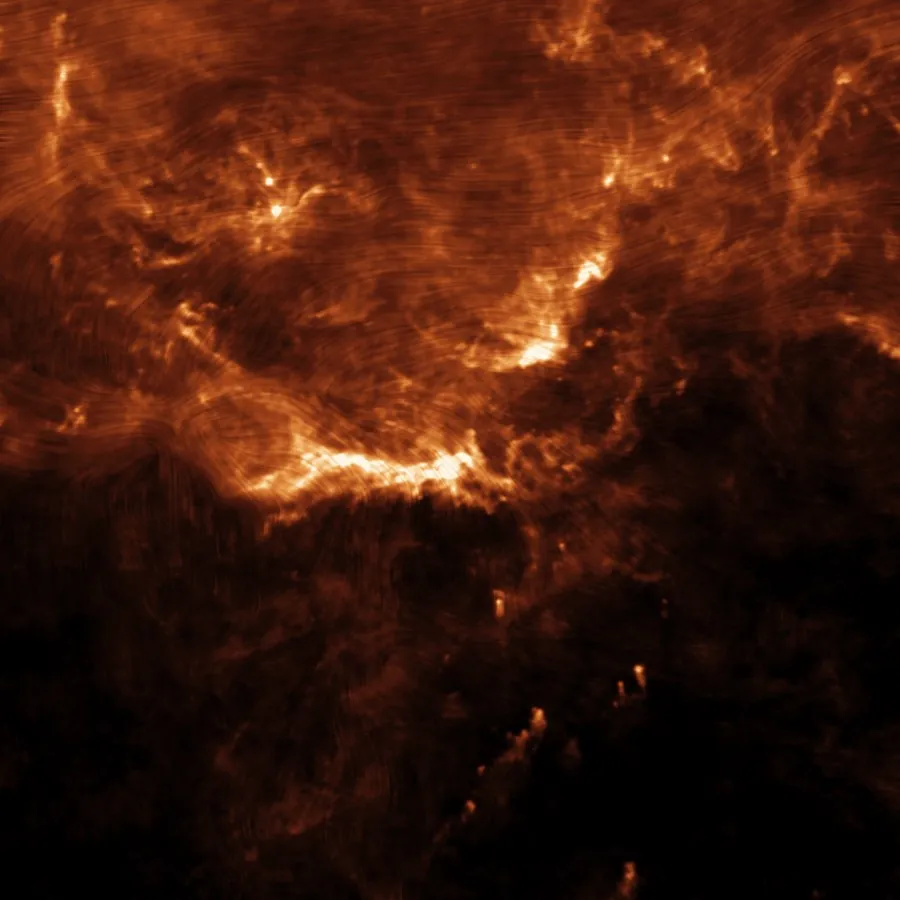
For filaments hosting Planck cold clumps, the orientation relative to the field depends on density. Low-contrast filaments in diffuse surroundings tend to run parallel to the field. In nearby filaments, where volume density can be estimated, the off-clump parts change from mostly parallel to mostly perpendicular at about 10^3 cm^-3 (Alina et al. 2019). Measuring that angle in large samples needs automatic detection, so the group builds neural networks, trained on Planck, Herschel and HI4PI maps or on synthetic images, that find filaments and return their position angle.
Results
What the papers report, in their own terms. Each item links to its source.
In low column density surroundings only low-contrast filaments run parallel to the background field; high-contrast ones are randomly oriented. In high column density surroundings there is no global preference, although low-contrast filaments alone tend to be perpendicular.
Alina et al. 2019In nearby filaments, where volume density can be derived, the parts away from clumps change from mostly parallel to mostly perpendicular to the field as density rises; inside the clumps the distribution changes from even to bimodal.
transition at nH ≈ 103 cm-3
Alina et al. 2019Across the 116 Herschel Galactic Cold Cores fields, filaments of low column density lie roughly parallel to the Planck field at all scales. At high column density, narrow filaments show no preferred orientation and wide ones tend to be perpendicular.
transition N(H2) ≈ 0.8–8 × 1021 cm-2
Oers et al. 2026For finding filaments and their orientation angles in Planck, Herschel and HI4PI maps, a combination of Mask R-CNN and U-Net worked best, and it trains on about 100 maps.
Alina et al. 2022
The U-Net on a real filament field
The group's network run on Herschel 250 µm in Mon OB1, with the Planck field for comparison.
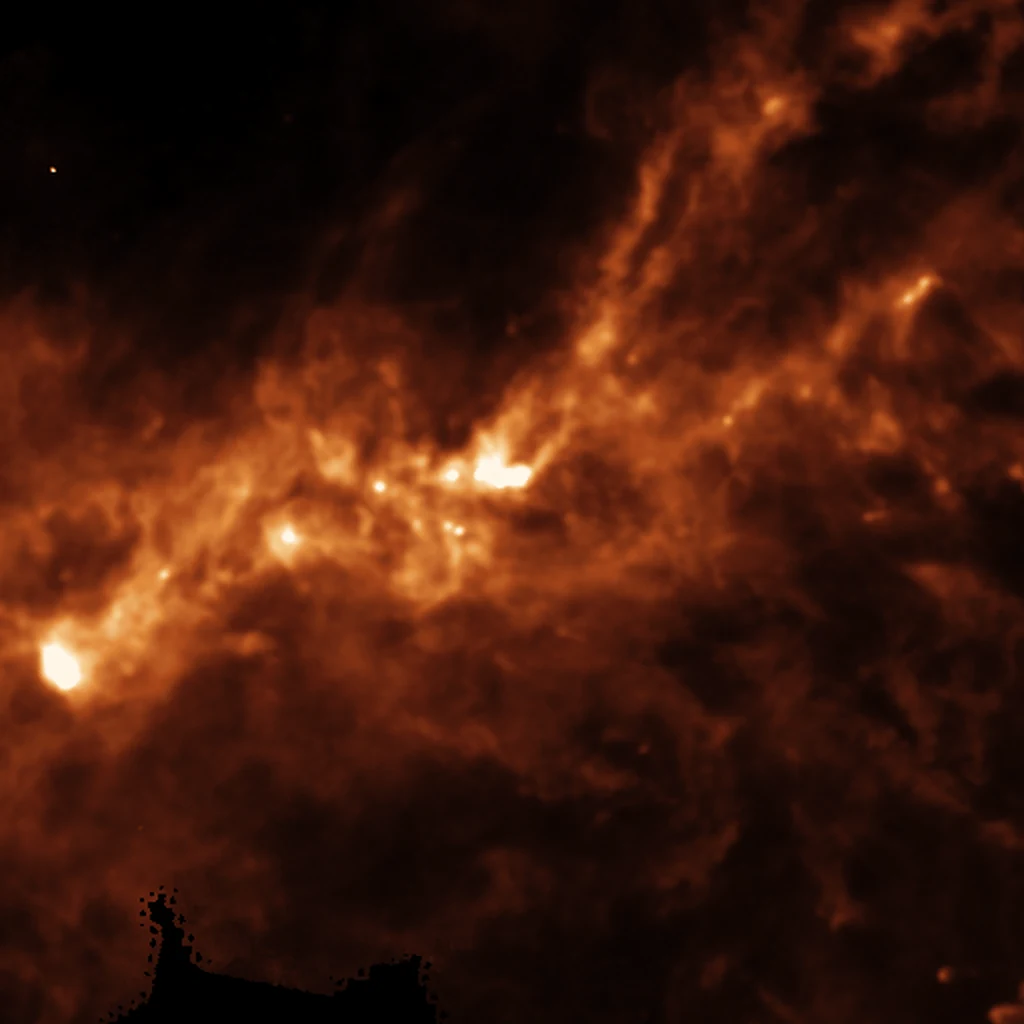
The network is the U-Net of Umetaliev, Alina and Salmenova (2025), code and weights from the authors (Zenodo, MIT licence). It was trained only on synthetic images of rotated rectangles, so every piece it returns is a guess at an orientation in a shape it has not seen. Input: Herschel SPIRE 250 µm (ESA HiPS), top-hat filter with a 15 px element and Otsu threshold (Otsu level 11), as in section 3.2 of the paper. The element size is our choice. Angles are measured from north through east, like the Planck field.
The field is Planck PR4 353 GHz, Q and U smoothed with a 5' Gaussian on top of the 4.8' beam, drawn every 5'. The region is G202.3+2.5 in Monoceros OB 1; Alina et al. (2022) mapped the large-scale field of the cloud with Planck. Ridge filter: multiscale Hessian of the log intensity. Histogram bins are 5°, counted in pixels, which are not independent: a long piece counts as many times as it has pixels.
Preview. The authors have not reviewed this region or the output.
Filaments and the field inside them
The public catalogue of Alina et al. 2019: 138 Planck filaments, 93 with a field angle.
The angle is the difference between the filament position angle from the SupRHT detection and the mean Planck 353 GHz field angle inside the filament, folded to 0 to 90°. Zero is a field along the filament, 90° is a field across it. The table lists 138 filaments; 93 have a field angle. The spread is the dispersion of the field angle in the filament, from circular statistics.
The published table does not carry what the paper binned: the field angle in the background, the column density of the environment, or the contrast. Its background column density column repeats the filament column density, so neither the environment split at 1.2 × 1021 cm-2 nor the contrast split at 4 × 1020 cm-2 can be rebuilt from it, and the paper's histograms count pixels, not filaments. This view is therefore a per-filament look at the field inside filaments, not a reproduction of Figures 5 to 8.
Data: Alina, D., Ristorcelli, I., Montier, L., et al. 2019, MNRAS 485, 2825, arXiv:1712.09325, table A1 via VizieR J/MNRAS/485/2825.
Papers
9 entries from NASA ADS. All publications →
- 2026Statistical analysis of the relative orientations between filaments and magnetic fields using Herschel and Planck data in star-forming regionsOers, Ristorcelli, Ferrière, … Alina (6 of 7) et al.Astronomy and Astrophysics, 711, A97 · arXiv:2606.047131 cit.
- 2026
- 2025Deep Learning for Position Angle Quantification Applied to Interstellar FilamentsUmetaliev, Alina, SalmenovaThe Astronomical Journal, 170, 2071 cit.
- 2025Temirkul/ism-filaments-analysis: U-Net for Angle Identification of Filamentary Structures --- First ReleaseUmetaliev, Alina, SalmenovaZenodo1 cit.
- 2024Neural Networks Unveiling Filamentary Structures in the Interstellar Medium: A Multi-Wavelength Approach Integrating Data from Advanced TelescopesAlina, Umetaliev32nd General Assembly International Union (IAUGA 2024), 104
- 2022MaLeFiSenta: Machine Learning for FilamentS Identification and orientation in the ISMAlina, Shomanov, BaimukhametovaarXiv e-prints, arXiv:2205.00683 · arXiv:2205.006836 cit.
- 2021Dust polarization studies on MHD simulations of molecular clouds: comparison of methods for the relative-orientation analysisMicelotta, Juvela, Padoan, … Alina (5 of 6) et al.Astronomy and Astrophysics, 647, A121 · arXiv:1810.100147 cit.
- 2020Statistics on the relative orientation between magnetic fields and filaments hosting Planck Galactic Cold ClumpsAlina, Ristorcelli, Montier, JuvelaIAU General Assembly, 104
- 2019Statistical analysis of the interplay between interstellar magnetic fields and filaments hosting Planck Galactic cold clumpsAlina, Ristorcelli, Montier et al.Monthly Notices of the Royal Astronomical Society, 485, 2825 · arXiv:1712.0932534 cit.